Eighty-Eight Keys and No Plans to Stop: The Men Who Still Play the Hotel Bar
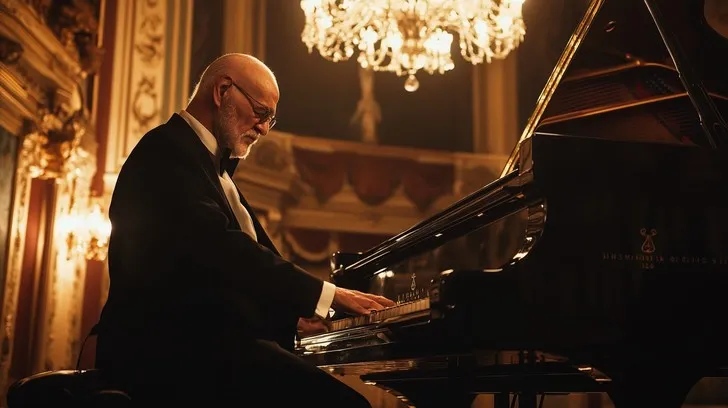
Photo: elderly pianist playing grand piano in dim hotel lounge bar, via images.stockcake.com
The first thing you notice about Marty is that he never looks at the keys. His eyes are always up, scanning the room like a lighthouse, cataloguing who walked in, who just got bad news, who needs the next song to be something specific.
He's been playing the same hotel lounge in downtown Cincinnati for nineteen years. Five nights a week, seven to eleven, with a fifteen-minute break nobody holds him to. When I asked him why he never looks down, he shrugged mid-chorus of "The Way You Look Tonight."
"The keys don't change," he said. "The room does."
The Gig That Refuses to Die
Every obituary for the lounge act was written decades ago. The big-band showrooms closed, the cocktail culture of the Mad Men era dissolved, and then streaming arrived to finish the job — why pay a man in a sport coat when a playlist is free?
And yet. Walk through a Marriott in Dallas, a Hilton in Seattle, a grand old property in Chicago's Gold Coast, and there he is: the piano man, wedged between the concierge desk and the bar rail, playing "New York, New York" for a crowd of six. Some of these guys are in their seventies. Some have played the same room longer than the general manager has been alive.
The economics make no sense, which is usually a sign that something else is going on. Hotels keep them because a live piano does something a sound system can't — it makes a lobby feel inhabited. It tells the business traveler eating alone at the bar that the world hasn't fully shut down for the night. It's ambience you can't download.
Who's Actually Listening
Spend enough nights in these rooms and the clientele sorts itself into recognizable constellations.
There are the road warriors, the sales reps and consultants with two drinks and a phone full of texts they're avoiding. They don't request songs. They just exhale.
There are the widows — and they are often widows, though not always — who come at the same time every week, sit at the same table, and tip generously. One player in St. Louis told me a woman attended his sets every Thursday for six years after her husband died. "He used to play this lounge on business trips," he said. "She says the piano sounds like him."
And there are the night owls, the locals who treat the hotel bar like a public living room because their actual living room is too quiet.
What they're all there for, I think, is the same thing: a third place with no entry fee, no dress code enforcement, and someone whose entire job is to make the room feel less alone.
The Request Economy
Every piano man has a system for requests. Marty's is simple: "$20, and it's yours. $50, and I'll pretend I like it." He says this with a grin, and everyone laughs, and someone inevitably pays the fifty.
The requests are a census of the American night. Bachelorette parties want Billy Joel. Divorced guys want Springsteen. The retiree in the corner wants Sinatra, always Sinatra. And every so often someone asks for something so specific — a song from a first dance, a lullaby in another language — that the whole room goes quiet, because everyone understands they've stumbled into somebody's memory.
The players learn to read this fluently. They know when to play upbeat and when to let a minor key do the talking. It's therapy with a tip jar, and the good ones are better at it than most licensed professionals.
What Happens When It Ends
Here's the part nobody wants to say out loud: this is a last generation. The young pianists aren't lining up for hotel gigs — they're producing beats in bedrooms, chasing algorithms. The men on these benches learned their trade in an economy of rooms, and rooms are what they know how to hold down.
So when Marty retires — and he says it's coming, though he's been saying it for years — the hotel will probably replace him with a speaker mounted above the bar. It'll be fine. Nobody will complain. The drinks won't taste different.
But something small will leave the room. The sense that a night has a soundtrack someone is choosing, in real time, for the people actually sitting there.
I asked Marty what he'd want played at his last set. He thought about it through half of a very slow "Moon River."
"Same thing I play every night," he said. "Whatever the room needs."
Then he turned the page, found the next song, and looked up at the crowd like he always does — never down at the keys, always out at the room.