Three Minutes and a Broken Heart: Inside the 11 P.M. Rooms Where America Workshops Its Pain
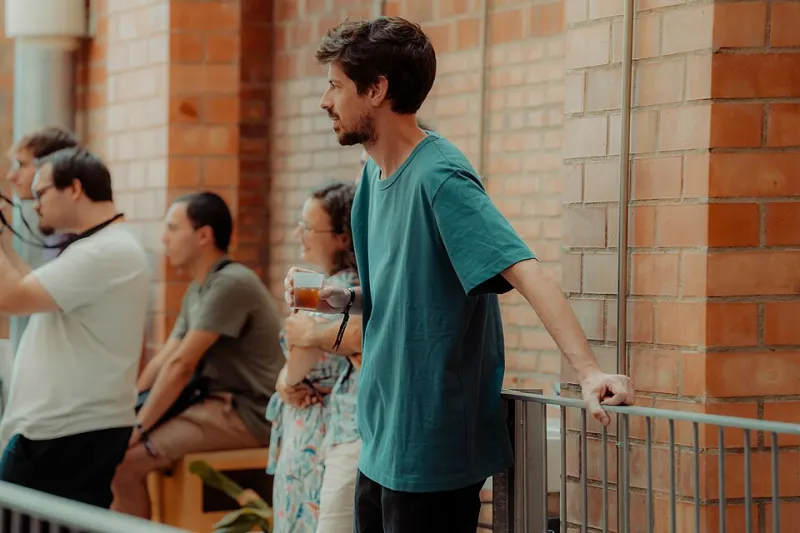
Photo: La Llama Store, CC BY 2.0, via Wikimedia Commons
There's a specific sound a room makes at 11 p.m. when nobody in it is being paid to be there. It's not silence, exactly. It's the hum of a beer tap, the creak of a barstool, and the low collective agreement that everyone present has chosen this — chosen to sit in a basement in Echo Park, or a pizza joint in Chicago's Logan Square, or above a laundromat in Bushwick, to watch strangers try out jokes that don't work yet.
I've been chasing that sound for two years now, from Portland to Philadelphia, and I've come to believe something I couldn't quite articulate at first: the late-night open mic is the closest thing America has left to genuine folk music. It's just delivered standing up, with a drink minimum, at an hour when the rest of the country is already asleep.
The Night Shift of the Soul
Walk into any midnight mic and read the room like a cast list. The nurse coming off a twelve-hour shift who wants to talk about the guy in room 4. The Uber driver who's collected nine hundred hours of passenger confessions and needs somewhere to put them. The bartender — there's always a bartender — who watches human behavior from the best seat in the house five nights a week and has finally decided to narrate it.
These aren't people chasing Netflix deals, or at least not only that. They're processing. The mic is cheap therapy with a two-drink minimum, and the audience is the group session. When a delivery driver in Tucson got up and did five minutes about his divorce, the laughs were real, but so was something underneath them — the sound of a man converting pain into a shape other people could hold.
That's the transaction. Country music did this for a century: three chords and the truth, honky-tonks full of people singing about heartache because their own needed somewhere to go. The 11 p.m. mic room is the honky-tonk's grandchild. Same function, different instrumentation. Instead of a steel guitar, there's a mic stand slightly too short for the comic. Instead of a ballad, there's a bit about dating apps that dies in the middle and then, miraculously, comes back to life.
Paying in Patience
Here's what makes these rooms folk art and not just open mics: nobody's buying a ticket. The audience pays in something more valuable at midnight — their patience, their attention, their Tuesday.
There's no door charge at most of these things. You buy a beer, you nod at the host, and you take your seat in the social contract. For the next two hours, you will watch material fail. You will watch a comic bomb so thoroughly that the silence develops its own weather system. And then, occasionally, you will watch a sentence land that you'll be repeating to your coworkers a month later, and you were there when it was born.
That's the deal the old folk audiences made too. Nobody went to a Kentucky porch picking session expecting polish. They went for proximity to the real thing — the raw version, before it got sanded down. The midnight mic audience is connoisseurship in its purest form. They can tell you which comics at which rooms are "about to pop." They take a weird pride in having seen the joke before the joke was good.
The Bringer of the Light: A Portrait in Two Acts
Every room has a host, and every host is a folk character whether they know it or not. At a Tuesday mic in Queens, the host — a day job accountant with a decade of stage time and zero industry heat — opens every show by reminding the room that "we're all here because our loved ones gave up on us." The crowd roars. It's a benediction.
He does the thing the old blues emcees did: he sets the terms. He tells the new comics the light turns red at three minutes. He protects the room's fragile ecosystem. When a drunk guy heckles a first-timer, the host handles it with the weary diplomacy of a village elder. This is tradition being transmitted in real time, orally, the way folk traditions always move.
And the material itself follows folk logic. Jokes at midnight mics aren't written so much as grown. A comic tries a premise about her mother's hospice care; it flops. She reshapes it the next week. By week six, it's a different animal — tighter, stranger, truer. The room edits it collaboratively, laugh by laugh, the way audiences shaped ballads for generations before anyone wrote them down. If a joke works at four different mics in four boroughs, it belongs to everyone.
Why It Matters at This Hour Specifically
You could ask why this has to happen after midnight. The answer is that honesty is a night shift job.
At 11 p.m., the performance of daytime life has ended. Nobody at the mic is pretending to have their life together, because the people they'd be pretending to are asleep. The room runs on a kind of mutual disarmament: I'll tell you the worst thing about my week if you laugh at it. That's the same trade the blues made, the same trade the honky-tonk made. Pain, reframed, offered to strangers.
There's also the matter of who's awake. The after-midnight crowd skews toward people whose lives don't run on the standard clock — service workers, insomniacs, the recently heartbroken, the creatively desperate. America's cultural gatekeeping assumes the interesting stuff happens on prime time. It doesn't. It happens in a 40-seat room above a taqueria where a respiratory therapist is workshopping a bit about her landlord that made me cry-laugh into a $6 lager.
The Last Song Sounds Like a Joke
I don't think every comic at these mics is an artist, and I don't think the rooms would want that label anyway. Folk traditions never do. But watch a room at 12:40 a.m., when the last comic of the night is doing material about her father's dementia and the audience is dead quiet in the way that means we see you — and tell me that's not the same current that ran through every American music born in a small room full of tired people.
The late show doesn't end. It just disperses. Everyone pays their tab, checks their phones, and steps out into the parking lot at 1:30 a.m. carrying somebody else's story, lightly disguised as a punchline, that they'll now keep forever.
That's how folk art has always survived. Not on stages. On the walk home.