The 10:30 Problem: What Wedding DJs Know About You Before You Do
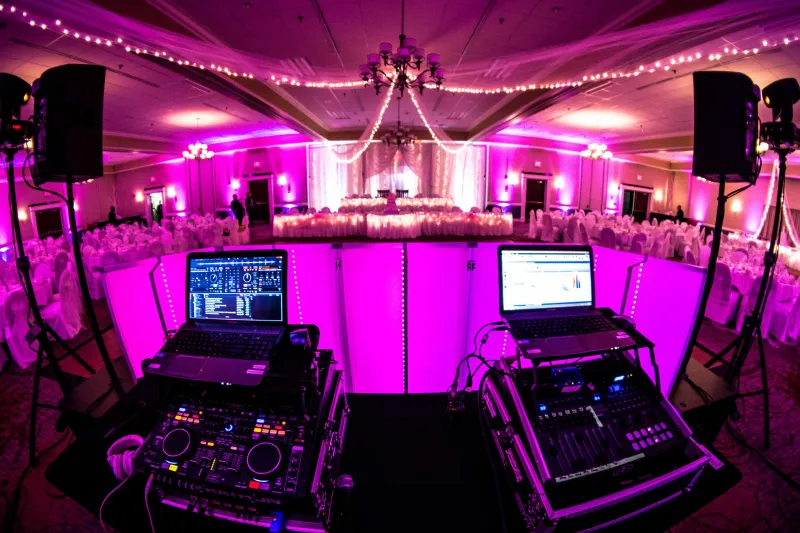
Photo: wedding DJ booth crowd dance floor reception lights, via i.pinimg.com
There's a moment at every wedding reception that nobody plans and everybody remembers. It usually happens around 10:30, give or take a toast. The cocktail-hour charm has burned off, dinner plates are stacked, and the dance floor — which was supposed to fill itself — is a parquet void with three flower girls on it. The band of the evening, the whole reason anyone booked the venue, is one bad song choice away from becoming a very expensive background hum.
The person who can feel that moment coming before anyone else does is usually standing behind a laptop and a light rig, wearing a shirt slightly too formal for the job. The wedding DJ.
Reading a Room Full of Strangers Who All Share One Cousin
Every DJ I spoke with described the same skill: reading a crowd that isn't a crowd yet. A wedding audience is a strange animal — eighty people who have nothing in common except knowing one couple. There's the college roommate, the boss, the great-aunt, the groom's fraternity. No nightclub DJ ever has to make all of those people happy at the same time.
"You're not playing for the room," a Michigan-based DJ named Marcus told me. "You're playing for the room's willingness to trust you." And trust, at a wedding, is fragile. One awkward transition during the parent dance and you can feel forty people quietly decide to sit back down.
So they watch. Not the dance floor — the edges of it. The people hovering near their chairs, the ones tapping a foot during a slow song, the table that hasn't laughed at a toast in twenty minutes. That's the data. The dance floor is just where the results get published.
The Rescue Song
Ask a working wedding DJ about their rescue songs and they'll talk about them the way a paramedic talks about a defibrillator. These are the tracks held in reserve for exactly the moment the floor goes cold.
The canon is remarkably consistent. "Shut Up and Dance." "September." "Don't Stop Believin'" — though several DJs admitted it's a gamble, because a third of the crowd will love it and a third will treat it as a personal insult. "Cupid Shuffle" and "Cha Cha Slide" are the nuclear options: no skill required, no age limit, no shame. When a DJ drops a line dance, what they're really doing is giving shy people permission to stand up without having to be good at anything.
"The rescue song isn't about the song," Marcus said. "It's about lowering the stakes. Nobody feels silly doing the Cupid Shuffle wrong. Everybody feels silly freestyle dancing wrong."
The Requests That Ruin Everything
Then there's the other side of the job: the requests. Every DJ has a story about the guest who asks for a twelve-minute prog-rock epic at 10:45, or the cousin who wants "one song, just one" that clears the floor like a fire alarm.
The professional rule, repeated almost word for word by everyone I talked to: the couple's do-not-play list is law, and the drunk guest at the booth is not the client. But enforcing that takes a certain diplomacy. You can't tell a groomsman no without the whole table hearing it. The good ones have learned to say "it's coming up" — a phrase that, one DJ confessed, is true maybe half the time.
The genuinely dangerous requests aren't the bad ones, though. They're the ones that are almost right. A slow jam at the wrong moment, a hip-hop anthem before the older crowd has gone home — a good song at the wrong time does more damage than a bad song ever could.
Why 10:30 Is the Whole Game
Ask any of them and they'll tell you the same thing: the reception has a shape, and 10:30 is the hinge. Early in the night, people are performing — dancing because it's expected. Late in the night, the survivors are dancing for themselves. In between is a valley, and the DJ's entire night is about building a bridge across it.
The tools vary. Some ride a tempo climb for forty minutes. Some engineer a singalong so big it resets the room. One veteran told me his trick is simply watching the bartenders — when the drink orders slow down, he knows he has about two songs before the energy follows.
There's something quietly moving about all of this. The couple spends a year planning the night, and this person — often the least photographed person in the room — is the one making sure it doesn't fall apart in the middle. They read the mood of your family better than you do. They know your grandmother will sit through anything but will lose her mind at "Twist and Shout." They absorb the blame when the floor is empty and hand away the credit when it's full.
So the next time you're at a wedding and the dance floor suddenly erupts at exactly the moment you were starting to think about leaving — that wasn't luck. Somebody saw you hovering by your chair, did the math, and pulled the right song out of the fire.
Say thanks. They'll wave it off. They've got a 10:30 to get back to.